


About Glenn Carson:
Glenn Carson of Cumberland County, PA is a banjo builder of national renown. He spoke with folklorist Amy Skillman about becoming a craftsman, the history of the banjo, and the winding path that led to his "holy grail" banjo hanging on his living room wall.
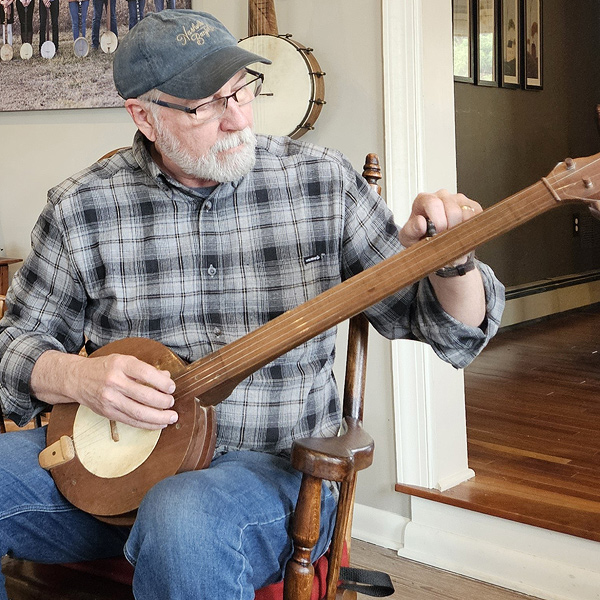
portrait of Glenn Carson by Amy Skillman
About Glenn Carson
Magic in our midst
To meet Glenn Carson, you would never know that this unassuming, quiet, down-to-earth gentleman is one of the premier banjo builders in the US. In fact, he recently sold a banjo to modern bluegrass star Billy Strings. And he lives right here in our midst! Glenn is a self-proclaimed graduate from the school of hard knocks — with no one to teach him, he had to figure it out himself — but his beautiful instruments make magic.
“Even as a young person, I was really drawn to good hand craftsmanship. When I saw a really good carving or engraving or something, I just was fascinated by that, and I wanted to do it.”
Glenn grew up outside Philadelphia but often visited his mother’s family farm in Bucks County. “For me, my favorite time of the year was anytime I got to go to my great-uncle’s farm, and sometimes I spent a summer with them... it saved me from all my knucklehead friends who were pulling me into a lot of stupid stuff. I learned how to drive, I learned how to fish, I learned how to shoot, how to take care of his chickens. It was just a really great experience. I guess I was drawn to the rural stuff.”
Taking a leap of faith
In 1975, Glenn came across the book Foxfire 3 in a bookshop: the third in a popular series of books describing Southern Appalachian folkways. That book had a lengthy article about making mountain banjos — some 80 pages of details, descriptions and measurements — and Glenn decided to make himself a banjo. It was a leap of faith. He had only a few simple hand tools, and no other information about banjo-making. He had never held a banjo, didn’t how to play it, and didn’t know much about the music.
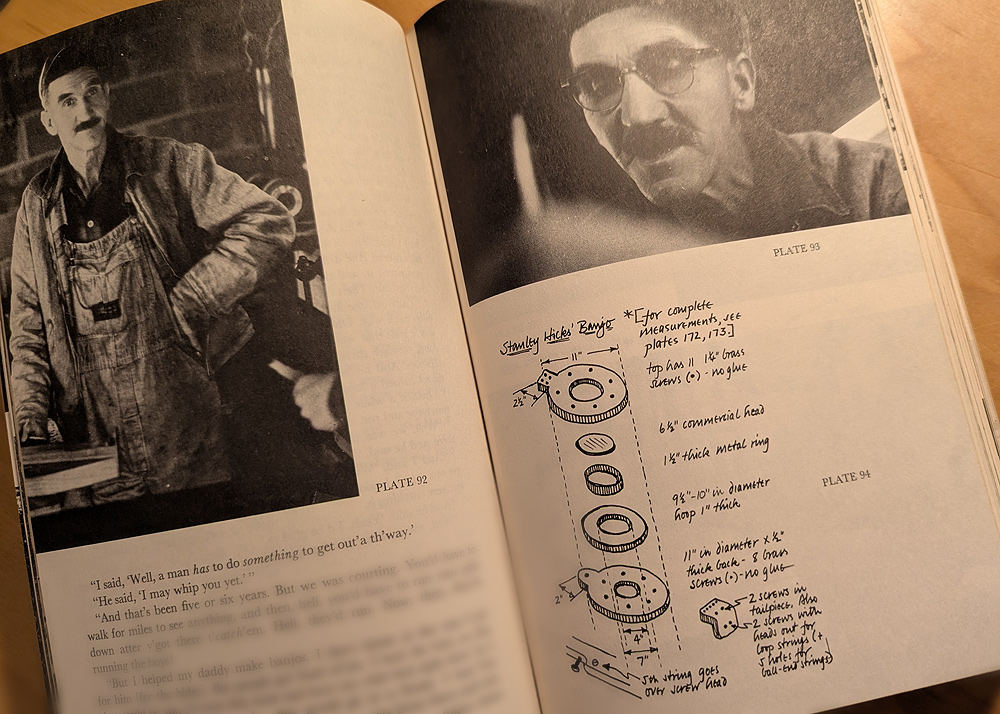
“I don’t even know why I did it really. It was strange. But I made this thing, and I met [local old-time musician Bob Buckingham] when I bought the strings — and he’s still a great friend — and it just snowballed.” Glenn bought the wood for that banjo from George Orthey in Newport, PA, who was making lap dulcimers at the time, but went on to become a renowned autoharp maker. Other local music connections that Glenn made early on were with Campbell’s music store in Spry, PA outside of York, and Mark Sherman’s Home of Bluegrass in Harrisburg, PA. The people he met were interesting and encouraging: “I got a lot of affirmation for doing this.”
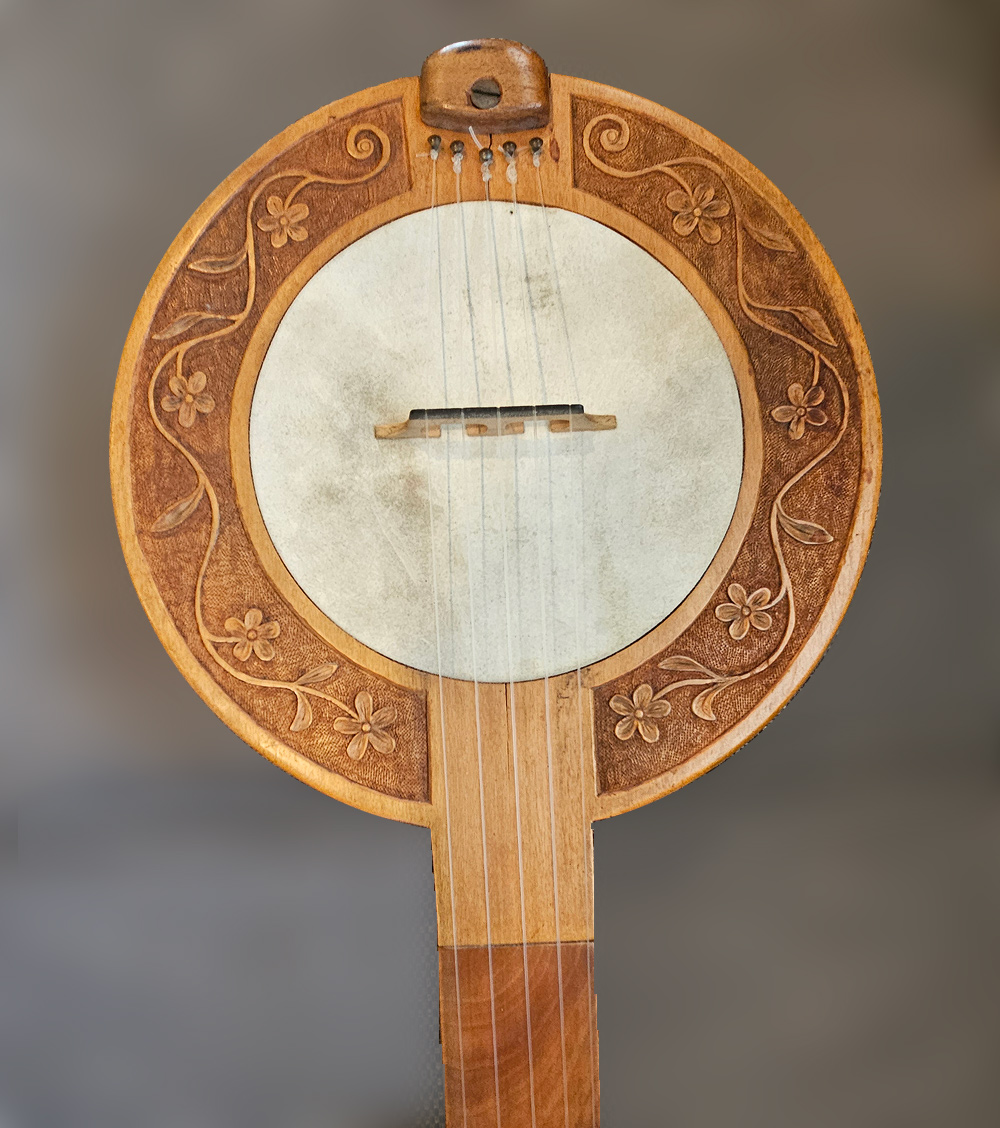
photo by Amy Skillman
Glenn laughs now at the poor quality of those first banjos. “I started out terrible. The first fretted banjo I made, I didn’t play very well, and I hadn’t really seen any quality fretted banjos close up. So, I inlayed that first one on every other fret — so that the fret markers [which usually guide the player to the right notes] meant nothing. If you were a player, you were always in the wrong place.” He joked that he eventually sold that banjo to a foreign exchange student just to “get it out of the country.”
The school of hard knocks
At least for the first 25 years of building banjos, Glenn considers himself a “hard knocks learner”. He never found anyone to teach him, and there were few resources to guide him. Instead, he found examples of beautiful instruments to look at, and tried to emulate them.
“That was pretty painful. But I had enough fun doing it, and I met enough interesting people that it was always rewarding enough to make me want to do another one, and it just kept going.”
“This was pre-internet; learning was really hard. Stuff that took me years, they can find in a day now. It’s just a totally different world. But there’s nothing like doing it. You can watch videos all day long, but it’s not the same as doing it. And there’s still a lot you can learn.”
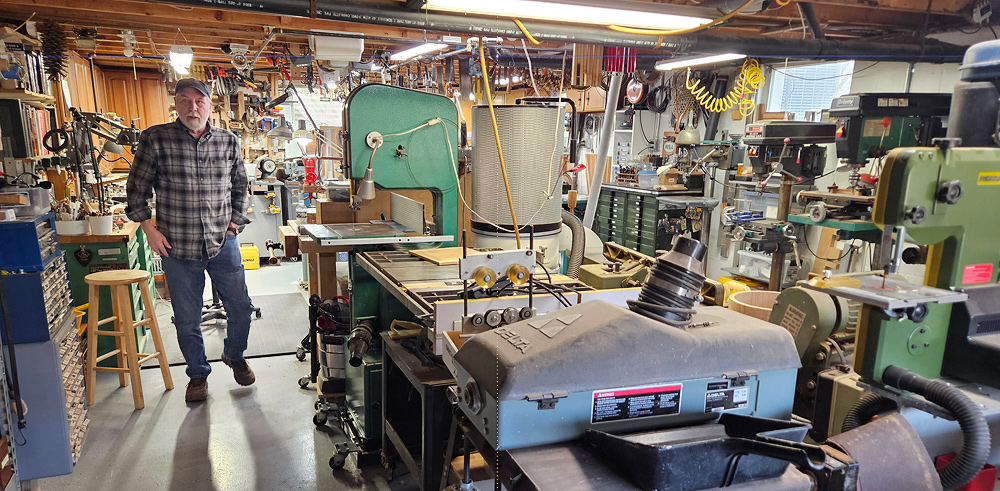
photo by Amy Skillman
Drawn to the music
Besides the art of craftmanship, Glenn also enjoyed music. “I liked Irish music, I’m Irish and Scottish, so I had this affinity for Irish music when I heard it. But in the 1970s, I was listening to Jimi Hendrix and a lot of rock and roll... And then I heard Doc Watson, heard him play Ramblin’ Hobo, and I thought it was the greatest thing I ever heard.” The music drew him into the broader old-time and bluegrass community. He and his friends would go listen to the highly popular Highwoods Stringband every time they could. “That was fun music, so I wanted to learn to play the fiddle and the banjo.”
Glenn started playing the fiddle in 1975 — the same year he started building banjos — and he taught himself to play the banjo as well, with the help of Bob Buckingham. When asked why he chose the banjo, when there are so many instruments that make up that old-time sound, Glenn says, “I love the sound. I love the fiddle ’cause it basically leads the music most of the time. But the banjo, clawhammer banjo, is just fun to play. It’s the rhythm of it. I guess I was drawn to both of ’em equally.”
Cheap entertainment!
Glenn and some coworkers created a band called the Shuey Brothers. “The name was a silly joke,” he says. The Shuey Family national reunion was coming to Hershey — one of the band members was married to a Shuey — and the organizers were looking for “some cheap entertainment”. So the guys all took fictitious Shuey Brother names (Glenn was Orvis Shuey because he liked fly fishing) and played bluegrass music for that family reunion. They continued playing together all through the 1980s and 90s, and never went by their real names.
Glenn has played fiddle in several traditional bands over the years. He played for ten years in a band called the Buc Hill Aces, with Brian Lockman on banjo, Glenn on fiddle, Glenn’s wife Pat on bass, and Brian’s wife Nancy on guitar. He also played with the Contra Rebels with Bob Buckingham and Todd Clewell, which played for local contra dances. Now he and his wife Pat play in an occasional band called the Potluck String Band, which primarily plays the older old-time music. This band includes Glenn on banjo, Pat on bass, Kirk Evans on fiddle and Jim Jones on guitar.
photo courtesy of the artist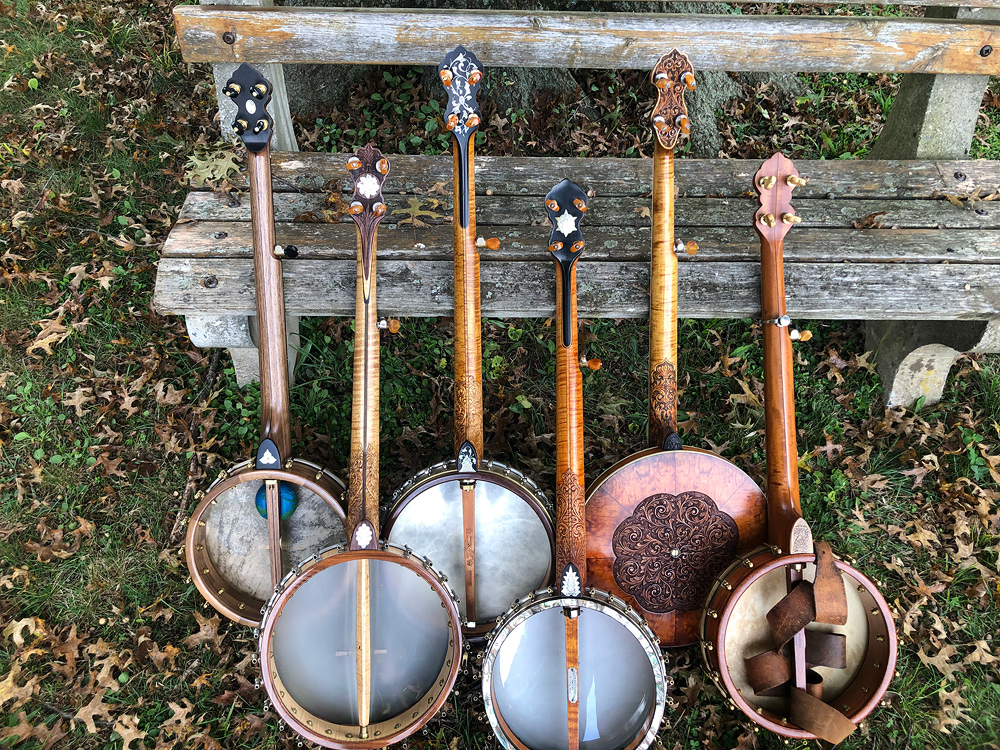
A misunderstood instrument
Glenn has noticed that in the luthier world, banjos are considered, at times, somewhat of a joke. Whether because of its origins, its sound, its simple structure, or something else, some other luthiers look down on the banjo. But Glenn has been committed to changing this perception.
“The banjo in the 1890s was a beautiful instrument. And it had some of the highest degree of workmanship of anything.”
“The best examples [of 1890s banjos] had engraved sea-snail inlays and wood carvings, and then metal engraving and all this stuff. And they were beautiful. But many [people] don’t know that.”
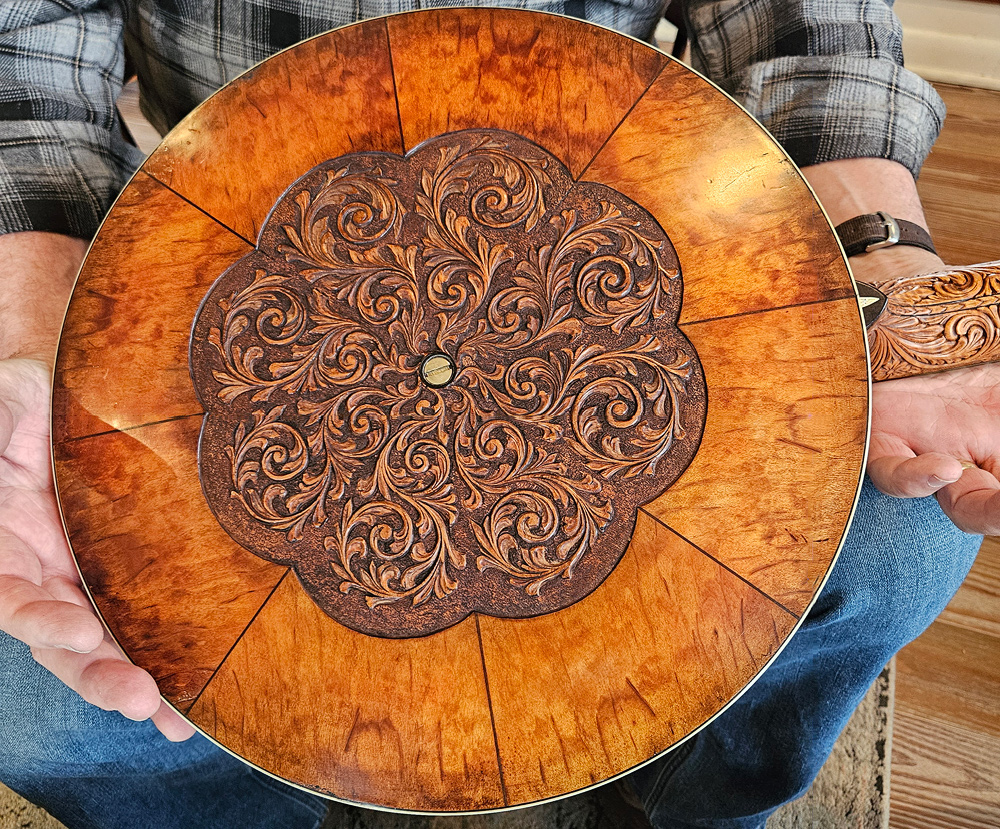
photo by Amy Skillman
During the 1890s, hundreds of patents were filed for new ideas with banjos: “patent wars,” Glenn calls that. “A lot of the best banjos were built in Boston and New York and Philadelphia by apprentices who had trained in Europe and came here. And so the workmanship was really beautiful.”
“Instead of a Steinway in your parlor,” Glenn says, “you’d have this Boston-made parlor banjo that cost a lot of money. They used Brazilian rosewood and curly maple and ebony, [and] metal and wood and pearl inlay.... They made some really gorgeous instruments.”
I was drawn to the music, I played clawhammer banjo, but I was drawn to the kind of arty side of those 1890 banjos.”
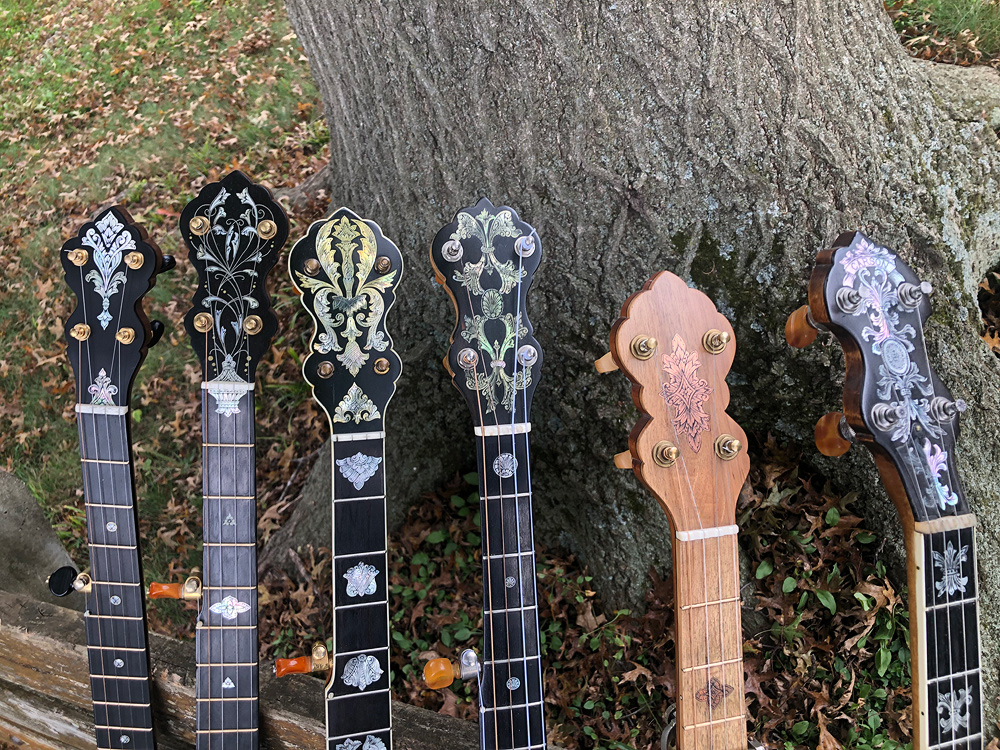
photo courtesy of the artist
Blended heritage
Glenn’s passion for the banjo, and for banjo music, has led him to become an aficionado of its history. He notes that the banjo was the most popular instrument in the country in the 1890s. But he also recognizes its popularity stands on the shoulders of a difficult history.
The banjo has its origins in West African “plucked lutes”. Enslaved people brought that tradition with them to the Americas. Those instruments featured a gourd covered with animal hide (as one might make a drum) as the resonator. The long wooden neck could accommodate four strings: three long strings running the full length of the instrument, and a fourth string that stops about halfway up the side of the neck. Enslaved people played and developed that instrument over the years in the Caribbean and the Americas.
The modern banjo is a hybrid, combining the drum-like body and different-length strings from the African tradition with the flat fingerboard and tuning pegs from European stringed instrument traditions.
The banjo was exclusive to African Americans until about the 1830s, when White musicians co-opted the instrument for minstrel shows and began to popularize the music. A fifth string was added at about the same time. The banjo has since become a staple in folk, bluegrass, old-time, Irish, and jazz music. Learn more at the Smithsonian’s online exhibit on banjos.
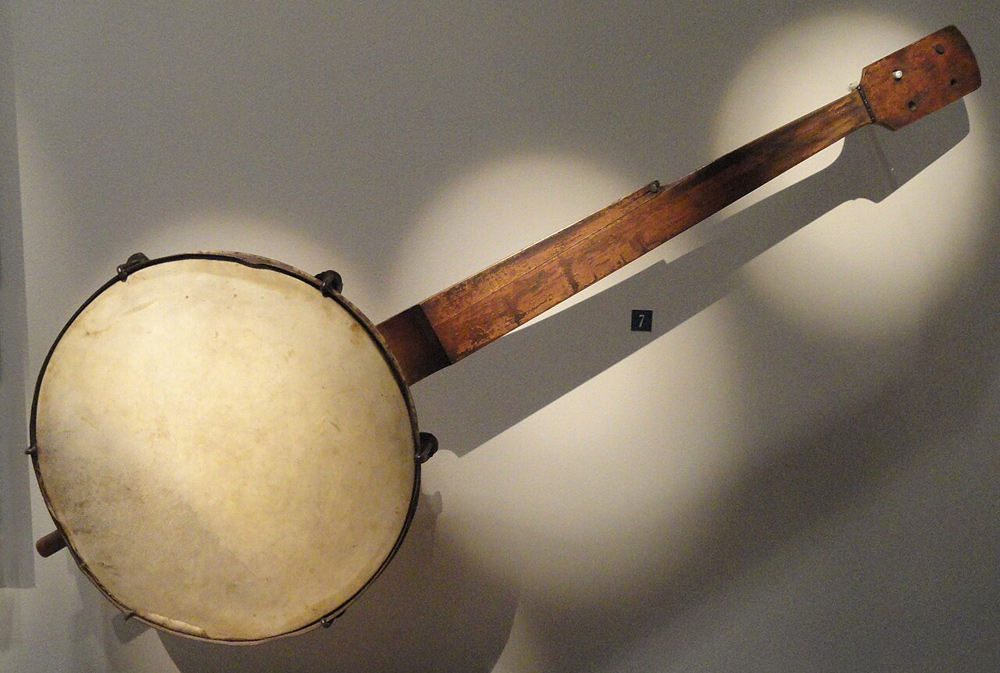
public domain photo from Wikimedia
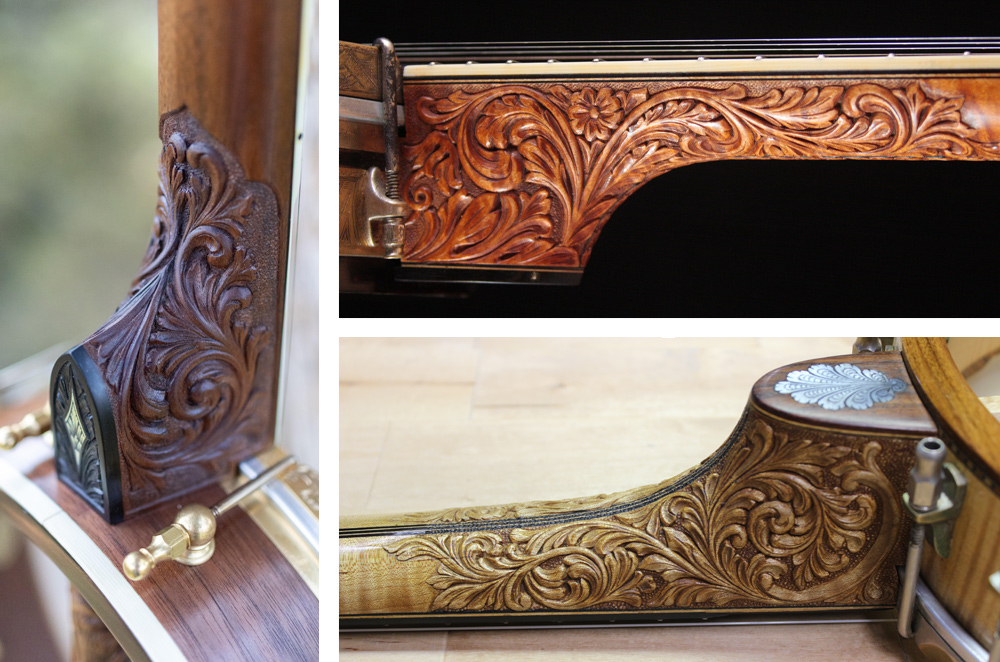
photos courtesy of the artist
Building on his own terms
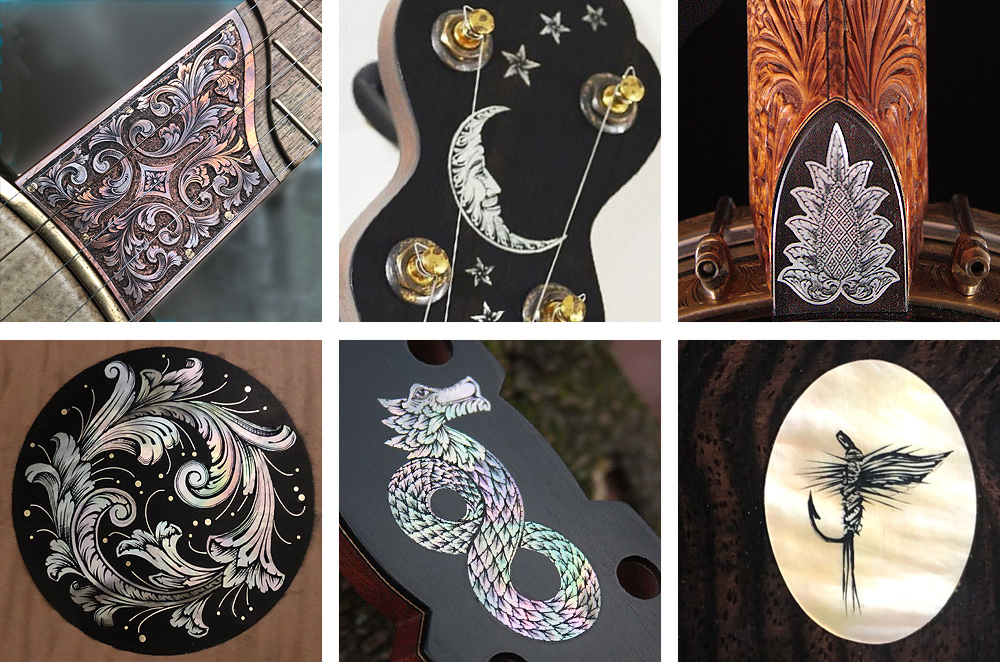
Beyond the sound of the instrument and the craft of shaping the wood, the artful engraving fascinated Glenn. In the 1970s he apprenticed himself to a gunsmith, learning the techniques of carving on gun stocks, as well as engraving on metal and mother of pearl.
After five or six years, he says, “I realized that I didn’t want to do that for the duration. So, I got out of it and decided that I’d get a different, unrelated job and keep this [banjo building] fun — do it on my terms rather than come to hate it by trying to make a living doing it. So, it was a real conscious decision and career switch.”
He found work at an environmental consulting company, designing and building groundwater cleanup systems. He eventually got several patents for specialized pumping systems, which freed him up to build banjos on the side when he had time. The environmental work often took him away from home for several days at a time. He’d bring along his tools and small pieces he could easily work on in his hotel room or sitting on the bank of a creek. “Every time I went on a trip, I took a banjo neck or guitar neck to work on.” He jokes that his “Hampton Banjo” was largely made while staying at a Hampton Inn for a long-term project.
Art for its own sake
Glenn epitomizes the artist who makes art for the sake of art, not as a career. He has valued the opportunity to work on his own schedule. “I’ve been under the radar,” he notes. “I’ve just never advertised. I never even made business cards or anything. I just... I’m not a high production kind of builder at all. In fact, I’m the opposite.”
Still, he thinks he has made about 70 banjos over the years. When he first started, it didn’t occur to him to number them, so he is not entirely sure. But he has also worked on hundreds of other instruments. “I got into doing the carving and pearl engraving and stuff like that. So, that’s been really a fun thing for me... to work with a lot of other builders [to embellish their instruments]. And that’s what I do a lot of now.”
photos courtesy of the artist
Building collaborations
Glenn met banjo builder Will Fielding in 2006 at Banjo Camp North (in Marlboro, Vermont) and they swapped banjos during a jam session. Will liked Glenn’s engraving work and asked if Glenn might want to collaborate with him. They built a lot of banjos together until Will’s passing in 2014. Glenn bought all of his leftover parts from Will’s wife Paula, including a banjo in progress, which he decided to finish as a tribute to Will.
“I knew what he had in mind for this one. When I got it, it was just a rough glued up neck block and parts for a rough rim. And I built it as his last one, kind of a tribute to him. His logo was a rooster, so I did an engraved copper rooster in the heel and put his stamp on the dowel stick.” He adds, a bit wistfully, “So, it’s our last collaboration.”
main photo by Amy Skillman; upper left courtesy of the artist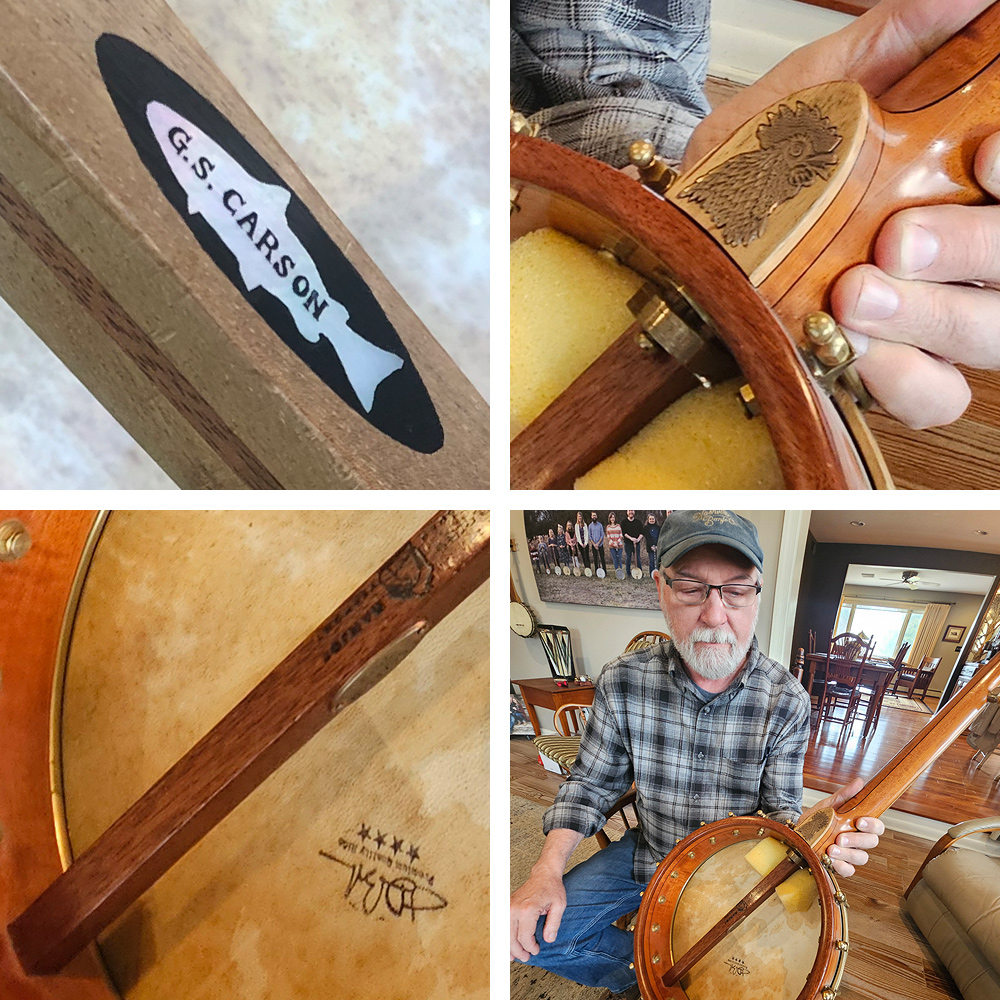
Glenn has sold many of his banjos, but still has some favorites hanging on the walls of his home. Listening to him talk about each of them is like taking a stroll through banjo history.
Innovating within the tradition
Glenn says he especially loves building open back banjos “...because of the history, and because the players are just a lot more willing to try different things. You can make ’em out of anything you want, pretty much... I’ve used all kinds of woods, cherry and walnut and maple and Oregon myrtle and sycamore and whatever.”
Glenn invokes the influential musician and banjo builder Kyle Creed from North Carolina, who changed the scales on his open back banjos by moving the bridge up closer to the center of the pot (main body). “And that’s because he grew up playing fretless banjos. On a fretless banjo, you can put the bridge anywhere you want it. And it has a warmer tone, the closer you get to the center of the pot. So, he changed his scales on his [banjo]... it’s a shortened scale from the Gibson Mastertone and many of the earlier turn-of-the-century banjos.”
Glenn recalls that several builders in the 1960s, including Peter and Bob Smakula (Goose Acres) and Glenn’s friend Kevin Enoch, were a big part of bringing Kyle’s idea to the modern open-back banjo. Glenn thinks he probably learned of the scale-length change from them. And now, he says, “pretty much every young modern open-back banjo builder is using Kyle’s idea.”
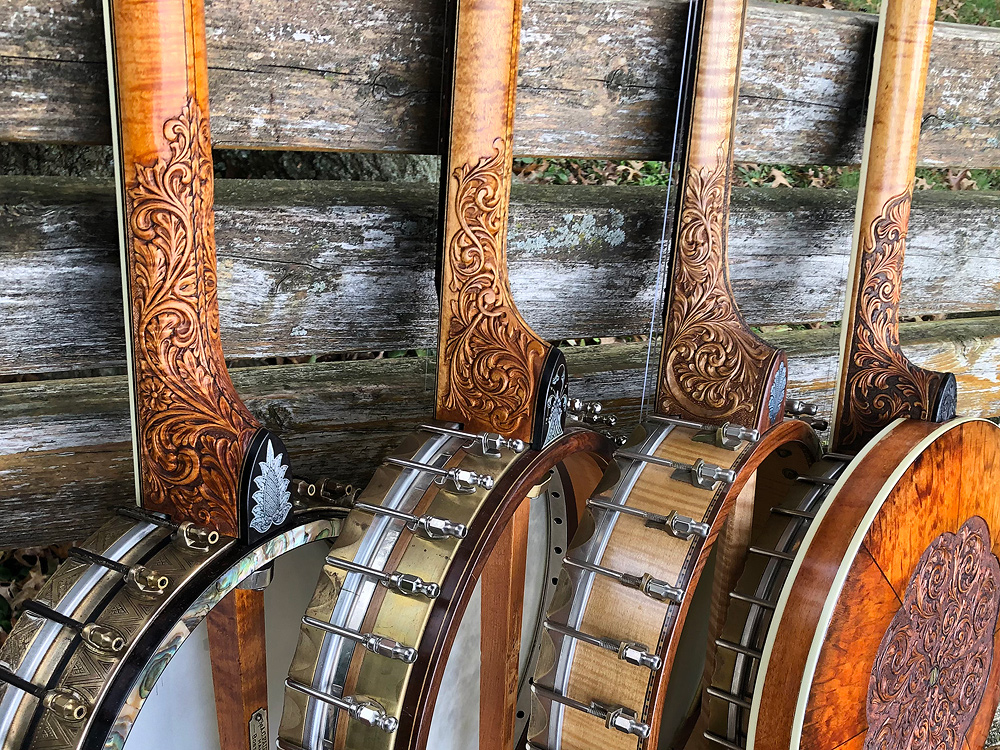
photo courtesy of the artist
A lot of factors impact the tone of the instrument. “The wood of the bridge impacts the tone. The tightness of the head and the material and thickness of the head impacts the tone. The length of the tail piece and the amount of downward pressure behind the bridge impacts the tone. The gauge of the strings, of course. And that’s what’s fun about these open backs: that you can really play with all these different factors. Whereas in the bluegrass banjos [which have closed backs], there’s just not as much you can do if you want to tweak the sound, as the tone most players seek is based on the classic pre-war Gibson Mastertone.”
When asked how he developed such a good sound in his banjos, Glenn says, “The more you make, you learn what you like, and what works and doesn’t work. There are a lot of okay ones, but every three or four, you get something really good. And then you want to repeat it and figure out how to do that.” This has led to several innovations that distinguish his banjos from some others.
A high-tech material
As a fisherman with an aptitude for mechanics, Glenn used to make his own fly rods out of carbon fiber. In one of his innovations, he started using an assembly of three carbon fiber rods inside the neck. That improved the sound and also made the necks more stable, which is helpful for the frequent re-tuning that is common for playing clawhammer banjo.
A scoop and a rest
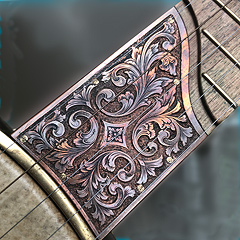
Glenn has added a scoop and an extended thumb rest to many of his open back banjos. Adding a scoop means removing material from the fretboard where it joins the round body of the banjo. That opens up more space under the strings, which makes it easier to play “up the neck” with the right hand. He says, “You can play down here [over the round part of the banjo, near the bridge]. But it warms it up just a little bit if you can get up the neck a little. The harmonics are at the 12th fret, which is halfway up the scale. So, the closer you get to that — it adds a nice tonal sound.”
Scallops on the hoop
In 1982, a few years before creating the Susquehanna Folk Music Society, founders John and Fiona Patterson helped to bring Mick Moloney and Eugene O’Donnell to Wilson College [Chambersburg, PA] for a concert. “I had a little display there,” Glenn recalls. “I had just finished a really fancy tenor banjo... gold plated and all... I only ever made two tenor banjos. And Mick came by and he saw this banjo... and he just sat and played it on and off during the afternoon.”
Mick Moloney, a renowned Irish musician, folklorist and ethnomusicologist, invited Glenn to visit him in Germantown when Glenn came to see his grandparents in Bryn Mawr. “I think I did that three or four times. And I got to really check out his tenor banjos. He had a Clifford Essex Paragon banjo, made in England, that had a scalloped tension hoop, which I just thought was really cool. That was not typical at all on American banjos. There was one American banjo that had scalloped hoops in the twenties, the Van Epps. But I hadn’t seen that before. And from the time I met Mick, I did it on almost every one of my own banjos: I scallop the tension hoop just ’cause I thought it was neat.”
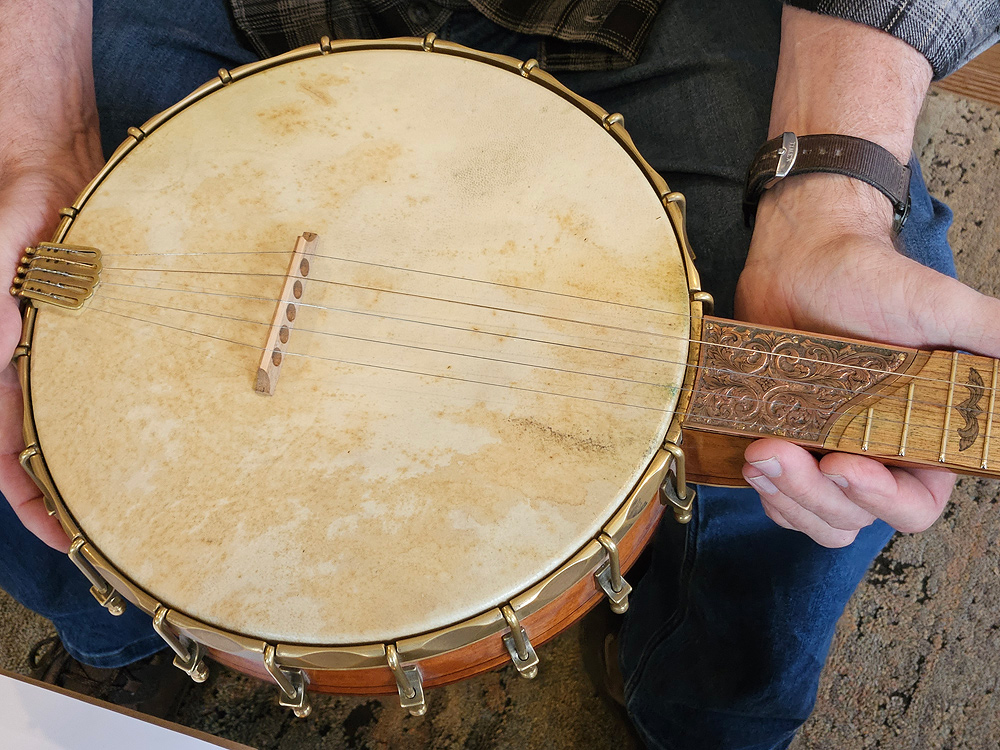
photo by Amy Skillman
The scallops also reduce weight. “I’ve been playing around a lot with weight reduction, just because I don’t think you need all that mass on ‘em. ... A Vega banjo from the twenties, for this diameter, would have 28 hooks, and they’d also have a metal band down here, which made ’em really heavy. ... I’ve made some with as few as 12 hooks rather than 30 or 28.” Glenn says that those pre-WWI banjos sounded good, but were just too heavy to be played comfortably. Modern banjos can also be surprisingly heavy — some bluegrass models can weigh 12 or 14 pounds! By comparison, depending on the construction, a Carson banjo weighs 4 to 7 pounds.
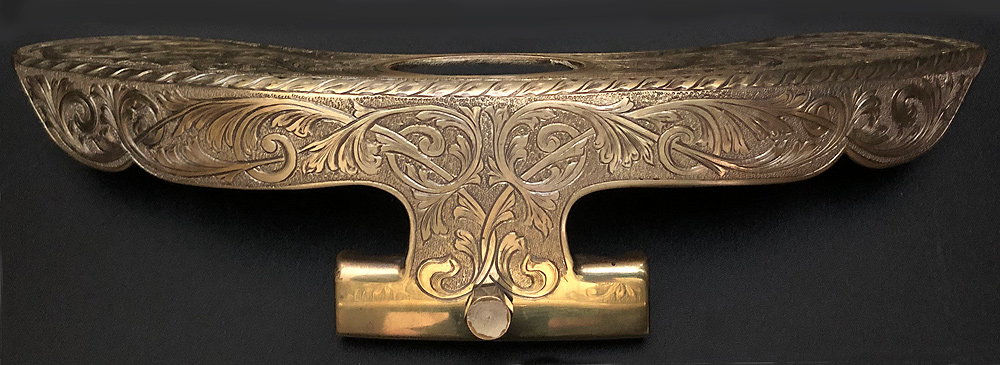
photo courtesy of the artist
Finding his niche
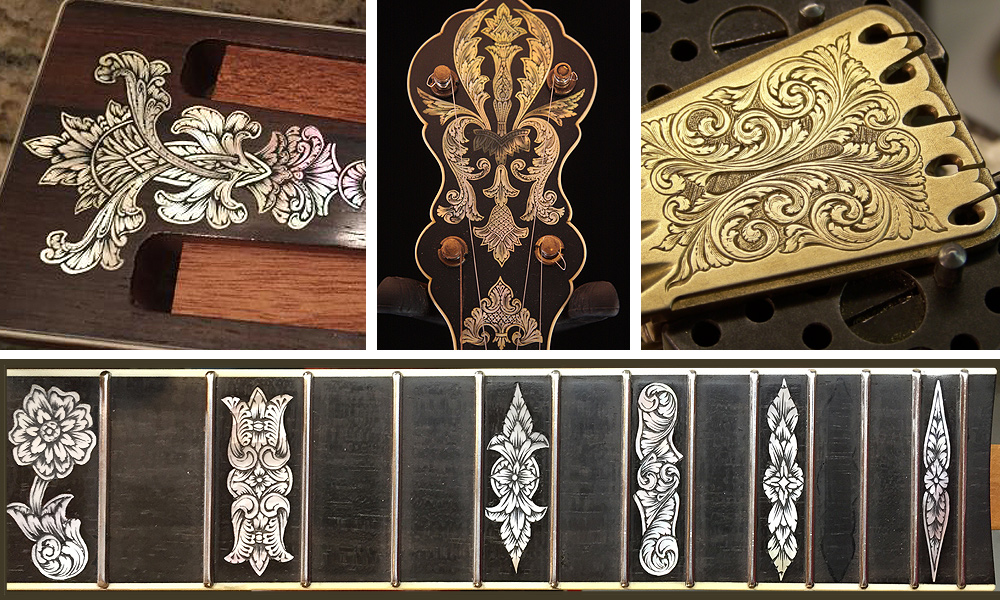
Glenn really found a niche for himself doing pearl engraving on the inlay work for guitars and banjos. He recalls, “I was in the middle of the Delaware River, standing there with a fly rod, and I got a phone call from this guy with a Vermont number. I thought it was my friend Will. But it was a guitar builder in Vermont, Michael Millard from Froggy Bottom Guitars. He said, ‘I got your name from Kate Spencer who saw your work for Will Fielding, and I need a pearl engraver for our 40th anniversary guitars. Can you do that?’ I was like, ‘I guess, yeah, sure,’ — mostly initially because Michael is also a fly fisherman and he had fished exactly where I was standing in the Delaware during that first call, so we really connected from the beginning.” Their partnership continues to this day, and brings Glenn back to the beautiful instruments of the 1890s.
photos courtesy of the artist
TOP left to right: engraved inlay for a Froggy Bottom Guitar * engraved pearl peg-head on Carson Vega Deluxe style banjo * an engraved banjo tail-piece * BOTTOM: custom fretboard inlays
“I cut [the mother of pearl] out first with a jeweler’s saw, and then inlay it [into the wood of the instrument], level it, polish it, and then engrave it.” It is a process that requires intense concentration, a steady hand, a clear eye, and a good imagination. “I was a doodler when I was a kid. I got in trouble in school ’cause I always drew on all my pages and so, Patty [his wife] says, now I just get paid to doodle. Yeah. I just always like to draw stuff like this.”
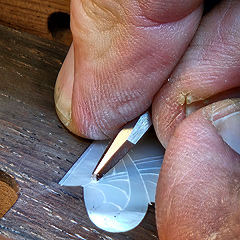
photo by Amy Skillman
“The engraving of the mother of pearl was very much a banjo thing, and that was from the 1890s. There was a great Italian pearl engraver who worked for Fairbanks Banjos, and he designed their inlays and did their best work for them. His name was Icilio Consalvi and his work is very collectible now... There’s a few other guys that do the same things that I do. But it’s not commonly done in mandolin and guitar building. So, I’ve found this little niche that I do for guitar companies...And it’s like, this one little unique thing they offer is this pearl engraving on their inlays and it’s really from the banjo world.”
Glenn enjoys these kinds of collaborations. “It’s just allowed me to meet a lot of really interesting people.”

Coming full circle
Glenn tells a remarkable tale of the past meeting the present. The first banjo Glenn made was modeled on the Stanley Hicks banjo in the Foxfire 3 book. Lifting a banjo down from its hook on his living room wall, he says, “It’s a funny story. Years later, when we started going to Clifftop [Appalachian Stringband Festival], we met a couple (Pat Shields and Janice Hall) from the Athens, Georgia area. They were potters and garlic farmers. We camped near them for years and became really good friends with them.
“We stayed overnight with them one time when we were driving through that area. They had a banjo hanging next to the fireplace. And I knew immediately it was either a Stanley Hicks or a Leonard Glenn banjo. So, I asked him who made it, and he said, ‘Oh, that’s the banjo Stanley made for Foxfire number three.’ And he gave it to me a year later, next time I saw him. And so this is actually the banjo that was made for the book, that I copied to make my very first one. So, it is like my holy grail banjo.”
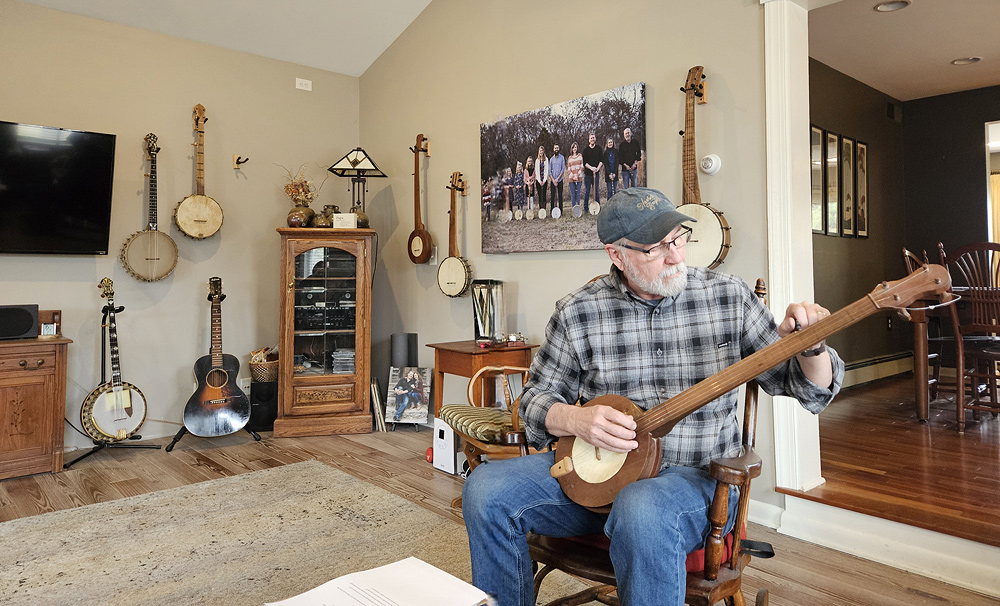
photo by Amy Skillman
Another aspect of coming full circle is that Glenn’s son Russ is also a very fine trad musician: he is the banjo player in Ricky Skaggs’s Kentucky Thunder bluegrass band! Russ has several videos on his YouTube channel featuring Glenn-Russ duets (“mostly filmed under my protest”, Glenn admits) and Russ playing banjos that Glenn made. “Russ is a huge part of my banjo life”, says his proud pop, “and like the Stanley Hicks banjo, a big part of ‘coming full circle’.”
Learn more at the Smithsonian
Glenn is one of the builders featured in Smithsonian Folkways “Conversations with North American Banjo Builders,” a 4-volume, 12-DVD series featuring 38 in-depth interviews with open-back banjo builders, historians and retailers. Glenn’s segment is in Volume 4. The series was filmed by Craig Evans.
The Smithsonian Institution in Washington, DC (and online at SI.edu) also has an interesting online banjo exhibit with articles, photos and videos about the history and building of that uniquely American instrument.





Brand icons for Facebook, YouTube, Instagram and other social media platforms are the trademark of their respective owners. No endorsement is implied.